


Choosing the right industrial blade
Selecting the correct industrial blade is not about choosing the hardest steel or the most advanced coating.
Cutting performance is created by 3 interdependent factors: the correct blade design and geometry for the application, the right base material, and a coating applied only when it delivers measurable benefits.
At Sollex, blades are engineered by defining the cutting geometry first, selecting the appropriate steel grade or material second, and applying a coating only when it improves performance. This structured approach ensures stable cutting, predictable results, and optimized blade lifetime in material production and converting.

Start with a proven standard blade
Many of Sollex's high-performance industrial blades have been developed in close cooperation with our customers and refined through real production experience. This has resulted in an extensive range of proven cutting solutions for different blade holders, materials and applications.
Before developing a new blade, we always recommend testing an existing standard solution. In many cases, the right blade is already available from stock. Starting with a standard blade is faster, more cost-effective and provides a reliable reference for evaluating cutting performance.
If the blade meets the requirements, no further development is needed. If it does not, the test results help us identify exactly what needs to be improved, whether it is the blade geometry, base material, coating or another design parameter.
What Sollex can specify
When a suitable standard blade does not fully meet the requirements of an application, Sollex can also develop or adapt industrial knives and cutting tools according to customer drawings, technical specifications, and specific production requirements.
Our capabilities include:
- Blade geometry and bevels: Two-facet and three-facet cutting edges, with customized bevel lengths, angles, and multi-facet grinding configurations.
- Base materials: Stainless steel, carbon steel, tool steels such as D2 and HSS-M2, as well as solid tungsten carbide and solid ceramic for demanding cutting applications.
- Edge surface finish: Precision-ground and polished surfaces with Ra values as low as 0.02 µm, depending on material, geometry, and finishing requirements.
- Coatings and surface treatments: Titanium, ceramic, zero-friction, and full ceramic coatings, selected according to the material being processed and the required performance.
- Quality documentation: For an additional fee, we can provide inspection documentation for each order, covering specified dimensions, tolerances, hardness, and surface finish.
If you cannot find a suitable blade in our standard range, contact us. We will first help you identify the closest existing solution to test before considering a customized blade design.
Blade design, geometry and shape
The first step in optimizing any cutting process is determining the correct blade design.
Blade thickness, cutting edge geometry, bevel configuration, grinding method, and cutting angle all influence cutting force, edge stability, wear resistance, and the quality of the finished cut.
Design comes first.
Even the most advanced blade material or coating cannot fully compensate for an unsuitable blade geometry.

Thinner blades generally require less cutting force and can reduce material deformation, helping prevent web breaks and improve cut quality. Multi-facet grinding and burr-free cutting edges can further improve cutting precision and distribute wear more evenly across the cutting edge.
Lower cutting resistance is particularly important when slitting thin, elastic, or sensitive plastic films, where excessive cutting force may cause edge tearing, stretching, or material distortion.
Multi-facet bevels and cutting performance
Cutting quality, cutting force, and blade lifetime are strongly influenced by the geometry of the cutting edge.
A single-facet bevel offers a simple cutting geometry, while multi-facet grinding allows the cutting edge to be optimized for different requirements.
By combining several precisely ground bevel angles, it is possible to balance initial sharpness, cutting resistance, edge strength, and wear resistance.
Typical bevel configurations
Two-facet and three-facet bevels provide different performance characteristics depending on their angles and dimensions.
A two-facet configuration can be optimized for a robust cutting edge with increased mechanical support. A three-facet configuration can be designed to improve edge penetration and reduce cutting resistance while maintaining adequate support behind the cutting tip.
The length of the primary bevel is another important design parameter. Shorter primary bevels generally create a more robust cutting edge with greater material support behind the cutting tip, while longer primary bevels provide a finer, sharper cutting geometry.
The correct combination depends on the material being cut, operating speed, blade thickness, cutting method, and machine setup.
Single-sided and double-sided grinding also influence cutting behaviour. Double-sided grinding generally provides a more symmetrical cutting geometry, while a single-sided bevel can improve edge control in applications requiring a specific cut orientation.
When changing from a three-facet to a two-facet design, the bevel angles and lengths may need to be rebalanced. This ensures that the new geometry maintains the required cutting quality and edge durability.
Send us a drawing or a worn blade. A worn cutting blade can provide valuable information about the cutting process. By examining edge wear, chipping, and deformation, Sollex can identify potential improvements to blade geometry, material selection, and surface treatment.

Edge surface finish – what Ra can Sollex achieve?
Surface finish is an important parameter in precision cutting, particularly for sensitive films, foils, laminates, and other technical materials.
Ra (arithmetical mean roughness) describes the average deviation of a measured surface profile and is expressed in micrometres (µm).
A finely finished cutting surface can reduce friction, support cleaner material separation, and help minimize unwanted particles or dust generated during cutting.
Sollex offers precision-ground and polished blade surfaces with Ra values as low as 0.02 µm, depending on the selected material and finishing method.
In specialized applications, Sollex has achieved surface roughness values below Ra 0.01 µm.
Specifying surface roughness on a technical drawing
Surface roughness requirements should be specified as a maximum permitted value, for example: Ra < 0.2 µm.
Tighter surface finish tolerances generally require additional processing and inspection, which can influence production costs.
Where required, surface roughness can be measured and documented using an agreed measurement method and defined inspection parameters.
Cutting angle and blade positioning
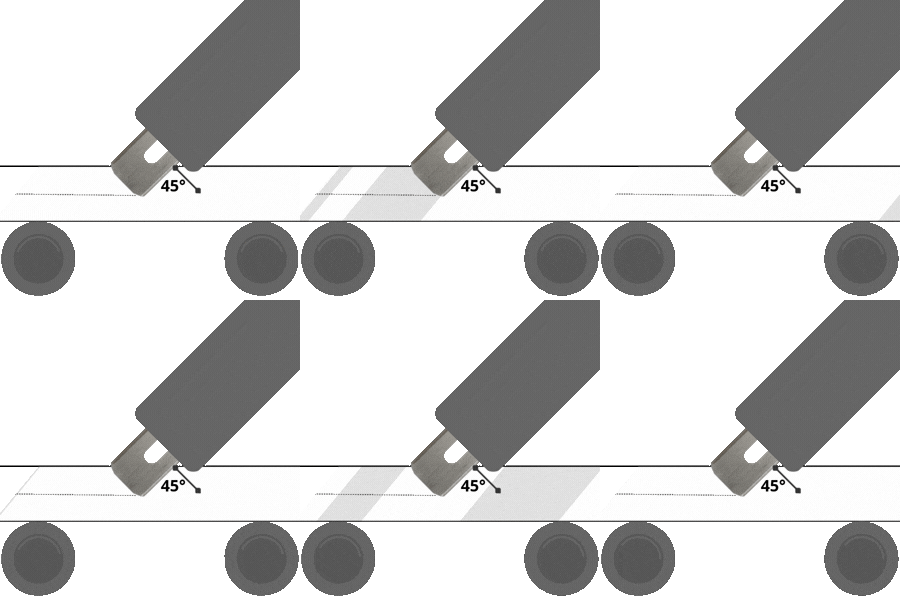
A cutting angle of approximately 45 degrees is frequently used in razor slitting applications to improve edge penetration and reduce resistance between the blade and the material.
The optimal angle depends on the cutting method, film properties, blade geometry, and machine configuration.
Correct blade positioning helps minimize friction, heat generation, and material deformation, particularly during continuous high-speed production.
When blade geometry, edge finish, and cutting angle are correctly matched, cutting resistance can be reduced before changes to the blade material or coating are considered.
Blade shape and design by application area
The shape and design of industrial knives depend on the material being processed, the cutting principle, and the operating conditions. Different cutting applications require different blade geometries to achieve reliable performance, consistent cut quality, and optimized blade lifetime.
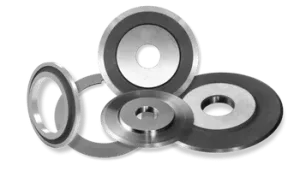
Machine knives for flexible packaging
Circular slitter knives, rotary score knives, toothed and serrated machine knives, pointed knives, perforating blades, crush cutters, tungsten carbide slitting knives, and top and bottom knives for shear cutting applications.
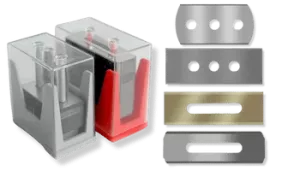
Industrial razor blades for film and foil
Slotted slitter razor blades with straight or rounded corners, three-hole industrial razor blades, injector blades, slitter-rewinder blades, coated razor blades, and solid tungsten carbide razor blades for demanding slitting applications.
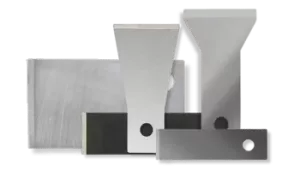
Knives for plastic recycling
Granulator knives, pelletizer die-face cutter blades, and other heavy-duty cutting tools designed for continuous operation and abrasive recycled materials.
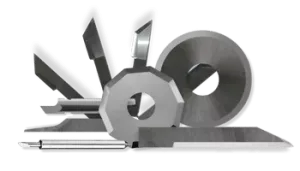
Plotter knives and blades for CNC digital cutting systems
Kiss-cut knives, drag knives, oscillating knives, routing bits, and cutting blades for vinyl, labels, films, textiles, composites, and other technical materials.
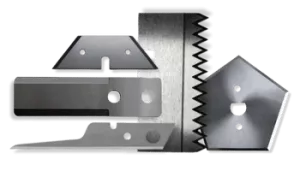
Customized cutting solutions
When a standard blade does not fully meet the requirements, Sollex can develop or adapt industrial knives and machine blades based on customer drawings, technical specifications, and application needs. Testing an existing solution first provides a useful reference for further improvements to performance, reliability, and blade lifetime.
Steel grade and base material
Once the blade geometry has been defined, the selection of the base material determines the cutting edge's hardness, toughness, corrosion resistance, wear resistance, and overall durability.
Material selection establishes the foundation of blade performance and helps determine whether additional coatings or surface treatments are necessary.
Carbon steel offers excellent cutting edge sharpness and is commonly used for clean materials where a fine cutting edge is essential.
Stainless steel combines corrosion resistance with reliable cutting performance and is particularly suitable for applications where moisture, hygiene, or corrosion protection are important. This makes it a preferred material for many food and pharmaceutical processing and packaging applications, where cleanliness, corrosion resistance, and consistent cutting performance are essential.
Tool steels such as D2 and high-speed steel HSS-M2 offer different combinations of hardness, toughness, and wear resistance, making them suitable for demanding industrial cutting applications.
For particularly abrasive materials or demanding production conditions, Sollex also offers blades manufactured from solid tungsten carbide or solid ceramic.
These advanced materials provide high wear resistance and extended blade life, but require appropriate blade design, mounting, and handling.
Stainless steel grades and hardness
Within stainless steel, Sollex works mainly with grades from the 440 series, which combine corrosion resistance with the hardness required for demanding industrial cutting applications.
Different stainless steel grades offer varying levels of hardness, wear resistance, toughness, and corrosion resistance.
Selecting the correct grade therefore requires consideration of both the cutting application and the required surface finish.
Harder materials generally provide improved resistance to edge wear, while achieving very fine surface finishes may require additional precision grinding or polishing.
For applications where conventional stainless steel does not provide sufficient blade lifetime, a suitable protective coating may improve wear resistance and cutting performance.
Material grade, hardness, surface finish, and coating should therefore be considered together rather than specified independently.

Blade coatings and advanced materials
Blade coatings and advanced cutting materials are used to improve cutting performance in demanding industrial applications.
Depending on the cutting process, they can reduce friction, improve wear resistance, protect the cutting edge, and extend blade lifetime.
Sollex offers four principal coating options – T, K, Z, and X – alongside advanced solid-material blade qualities C and V.
The optimal choice depends on the material being cut, the presence of abrasive additives, cutting speed, temperature, and the type of wear experienced during production.

Choosing between Sollex blade qualities
Different coatings and blade materials offer different advantages depending on the cutting application. The following overview helps identify the most suitable Sollex blade quality.
| Quality | Technology | Best suited to |
|---|---|---|
| T – Titanium | Titanium nitride (TiN) coating | Plastic film and foil with few abrasive additives |
| K – Ceramic | Ceramic edge coating | Plastic films containing abrasive additives such as calcium carbonate |
| Z – Zero-Friction | Low-friction coating | Thin and stretched plastic films, especially at high cutting speeds |
| X – Full Ceramic | Ceramic coating on the cutting edge and blade sides | Multilayer films and films containing demanding abrasive additives |
| C – Solid Ceramic | Solid ceramic blade material | Soft, elastic, and highly demanding plastic films, including EVA |
| V – Solid Tungsten Carbide | Solid tungsten carbide blade material | Hard, abrasive, and laminated plastic films |
A coating is not automatically an improvement. The best solution depends on the specific cutting problem. A coating may reduce friction, protect against abrasive wear, or improve blade lifetime, but may offer limited benefits if the existing blade already performs as required.
Sollex can recommend evaluation blades with different coating and material configurations to help determine the most suitable option for a specific production process.
Titanium
For general slitting performance
Titanium nitride (TiN) is a gold-coloured coating that increases cutting edge surface hardness and improves resistance to wear.
Its low-friction properties can contribute to cleaner cutting and reduced dust formation in suitable applications.
Titanium-coated blades are particularly suitable for plastic films and foils with relatively few abrasive additives.
Material to cut: Plastic film and foil with few additives.

Ceramic
For abrasive additives
Ceramic-coated blades feature a black, fine-grained protective coating designed to improve cutting edge durability.
The coating provides additional protection against abrasive wear, particularly when cutting plastic films containing additives such as calcium carbonate, chalk, or titanium dioxide.
K-quality blades are suitable for applications where conventional blade materials wear prematurely due to abrasive particles.
Material to cut: White plastic film and other films containing abrasive additives.

Zero-Friction
For high-speed cutting of thin film
Zero-Friction blades feature a grey, exceptionally fine coating designed to minimize friction between the cutting edge and the processed material.
Reduced friction can help limit heat generation, improve cutting consistency, and extend blade lifetime during high-speed slitting.
Z-quality blades are particularly suitable for thin, stretched, and sensitive plastic films where low cutting resistance is essential.
Material to cut: Thin stretched plastic film, including high-speed stretch film applications.

Full Ceramic
For extremely abrasive applications
X-quality blades feature a full ceramic coating that protects both the cutting edge and the sides of the blade.
The extended coating coverage offers additional protection against abrasive wear when processing films containing demanding additives or multiple layers.
These blades are designed for applications requiring particularly high durability and consistent cutting performance.
Material to cut: Multilayer plastic film and films containing abrasive additives.

Solid Ceramic
For extreme performance
C-quality blades are manufactured from solid ceramic rather than conventional steel with a protective coating.
Solid ceramic provides exceptional resistance to abrasive wear and heat, making it suitable for demanding cutting applications.
The material is characterized by a self-sharpening effect during use, helping the blade maintain its cutting performance over extended production runs.
C-quality blades deliver extreme durability and performance, particularly when cutting soft, elastic, or abrasive plastic films.
Due to the brittle nature of solid ceramic, careful handling and correct blade mounting are essential.
Material to cut: Soft and flexible plastic films, including EVA, as well as demanding multilayer films.

Solid Tungsten Carbide
For hard and laminated film
V-quality blades are manufactured from solid tungsten carbide, an exceptionally hard and wear-resistant cutting material.
Unlike coated steel blades, solid tungsten carbide provides wear resistance throughout the blade material.
These blades are particularly suitable for cutting hard, laminated, and abrasive plastic films, including multilayer packaging materials and films containing demanding additives.
The high hardness of tungsten carbide helps maintain cutting edge sharpness and provides excellent durability in continuous industrial production.
Material to cut: Hard and laminated plastic films, including PE, PP, and PET-based films with abrasive additives.

Food-contact compliance
For industrial blades used in food processing and food packaging applications, material suitability and regulatory compliance are important parts of the technical specification.
Sollex can provide information and supporting documentation concerning the applicable food-contact requirements for relevant blade materials and coatings.
Within the European Union, the general framework for food-contact materials is established by Regulation (EC) No 1935/2004, together with other applicable requirements.
Compliance must be evaluated according to the specific blade configuration, intended application, and relevant contact conditions.
For applications requiring food-contact documentation, customers are encouraged to provide details about the processed materials, operating conditions, and intended use.
Sollex can then confirm the relevant documentation available for the selected cutting solution.
Why choose Sollex as a supplier of industrial blades and machine knives
Sollex specializes in industrial knives and cutting blades, combining technical expertise with extensive experience in material processing and converting applications.
Our approach starts with the cutting process itself. We evaluate blade geometry, select the appropriate base material, and recommend coatings or advanced blade materials when they offer measurable performance advantages.
What Sollex offers
- Extensive range of standard blades: Proven cutting solutions for many common blade holders, materials and industrial cutting applications, with many products available directly from stock.
- Precision blade geometry: Standard and customized two-facet and three-facet bevels, grinding angles, cutting edge profiles, and blade dimensions.
- Extensive material selection: Stainless steel, carbon steel, tool steels, solid tungsten carbide, and solid ceramic.
- Controlled surface finish: Precision grinding, polishing, and Ra surface roughness measurements for demanding cutting applications.
- Application-specific coatings: Titanium, ceramic, zero-friction, and full ceramic coatings selected according to cutting conditions and material characteristics.
- Technical and quality documentation: Inspection reports, specified tolerances, hardness measurements, surface finish documentation, and relevant compliance information on request.
- Cutting tool specialists since 1927: Nearly a century of experience supplying industrial knives and blades to customers across a wide range of industries.
Whether you want to optimize an existing slitting operation, reduce blade changes or improve cut quality, Sollex will first help you identify an appropriate standard cutting solution. If existing blades do not meet your requirements, we can evaluate a customized machine knife or blade design.
Contact our technical team to find a suitable standard blade for evaluation. If needed, you can also send a drawing for a customized quotation.


