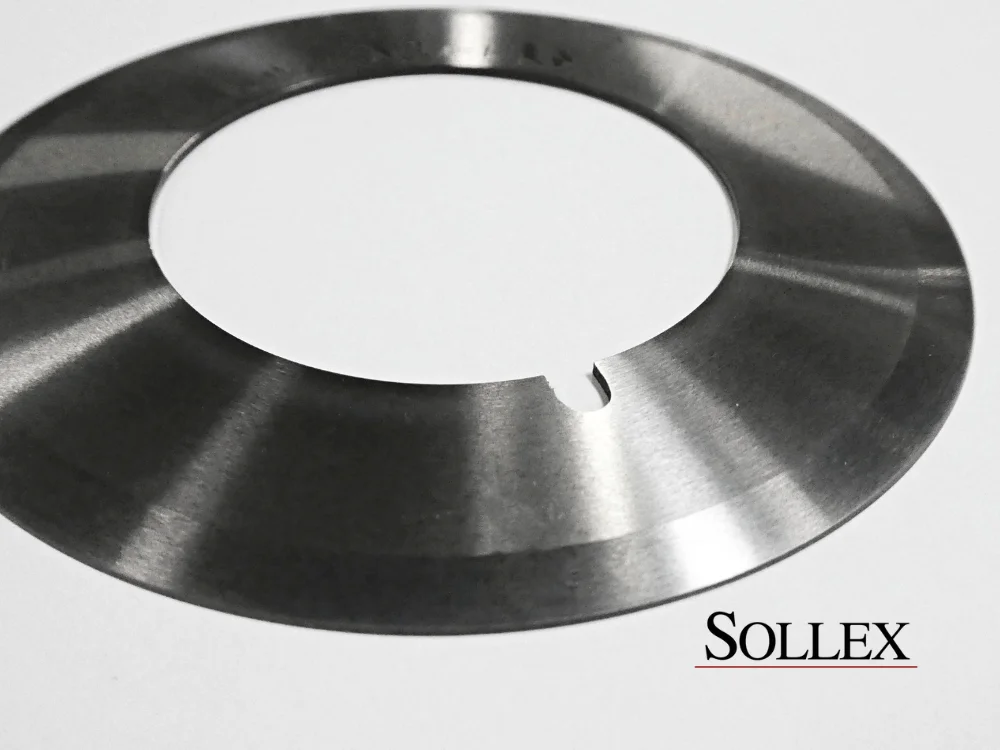
How a Blade Investment Helped Increase Output by 100% on a W&H FILMEX II Stretch
In high-speed cast stretch film production, blade performance directly affects output, uptime and roll quality. This case shows how Sollex 4-60-030-Z helped a European producer running a W&H FILMEX II Stretch increase production speed from around 300 m/min to 400–600 m/min, extend blade life by up to 1400% and achieve seven days of stable production.
Sollex 4-60-030-Z improved blade life, output and film quality in thin stretched cast film production
In high-speed cast stretch film production, the slitting blade is a small component with a direct impact on output, uptime and final roll quality.
For a leading European stretch film producer running a Windmöller & Hölscher FILMEX II, switching to Sollex 4-60-030-Z helped increase output by up to 100%, extend blade life by up to 1400% and improve the consistency of finished film rolls.
The blade investment was around per blade.
The production impact was significantly larger.
At a glance: small blade, measurable production gain
Customer: Leading European producer of cast stretch film Application: Thin stretched film slitting on a cast film line Machine: Windmöller & Hölscher FILMEX II Stretch Blade: Sollex 4-60-030-Z Material: Cast stretch film / thin stretched film Previous production level: Approximately 300 metres per minute Improved production window: Approximately 400–600 metres per minute Output impact: Up to 100% higher output when moving from 300 to 600 metres per minute Blade-life impact: Up to 1400% longer blade life in measured production comparison Stability target: Minimum one day of stable blade performance Result: Seven days of stable production Quality impact: Cleaner film edges, more stable roll build-up and improved product consistency
The challenge: standard blades limited production performance
The customer was producing thin stretched cast film on a
W&H FILMEX II Stretch, a production environment
 built for high efficiency, stable reel geometry, controlled film tension and consistent film quality.
The previous blade solution worked at lower production speeds, around 300 metres per minute. But as the customer pushed the line towards 400–600 metres per minute, the limitations became clear.
Blade wear increased. Slitting performance became less stable. Blade changes were needed too often. The risk of edge variation, film-edge instability and roll quality issues increased.
At these speeds, even small changes in friction, heat, vibration or blade positioning can affect the film. If the blade starts to create an inconsistent cut, the film edge can become unstable during winding. That can affect roll build-up, roll diameter, roll density, weight accuracy, metre count and final product quality.
The customer needed a blade solution that could support higher output without sacrificing film quality.
The real cost: not the blade price, but lost production
A slitting blade in this application costs around .
But in high-speed cast film production, the real cost is rarely the blade itself. The real cost is what happens when the blade causes downtime, waste, quality issues or unnecessary operator intervention.
One unplanned stop can quickly become expensive through lost machine time, scrap, start-up waste and production disruption.
That changed the commercial question.
The question was not: “Which blade is cheapest?”
The question was: “Which blade keeps the cast film line running longer, faster and with stable quality?”
The technical requirement: thin stretched film demands control
Thin stretched cast film is sensitive to friction, heat, vibration and edge instability.
The blade must cut cleanly, but it must also remain stable during long production runs. Sharpness alone is not enough. The full slitting process must work: material, machine speed, blade coating, blade position, blade angle, holder stability and winding behaviour.
In this application, the key process factors were film thickness, line speed, film tension, blade coating, blade angle, blade position, holder rigidity, friction against the blade, heat build-up at the slitting edge, edge quality, roll build-up, reel geometry and blade change routines.
This is why Sollex treated the case as a slitting-process optimization project, not as a standard blade replacement.
The Sollex solution: 4-60-030-Z mounted in the W&H cast film line
Sollex supplied and tested blade alternatives for the customer’s Windmöller & Hölscher FILMEX II Stretch cast film line.
The method was based on real production conditions. Around 20 blade variants were tested during one week under the same operating conditions: the same film recipe, the same machine, the same application and the same cast stretch film production environment.
From the initial test, three blade options were selected for extended production trials. These were tested over a longer period to compare blade life, edge quality, process stability, friction behaviour and performance at higher line speeds.
After this evaluation, Sollex 4-60-030-Z was selected as the best-performing solution.
The blade was chosen for the specific demands of thin stretched film: high speed, low friction, stable edge quality, predictable blade life and long continuous production runs.
The goal was not simply to install a sharper blade.
The goal was to create a more stable slitting process that could support higher line speed, cleaner edges and more consistent winding performance.
The result: from 300 m/min to 400–600 m/min
After implementing Sollex 4-60-030-Z, the customer could increase production speed from approximately 300 metres per minute to a stable production window of approximately 400–600 metres per minute.
At the upper end of that range, the line moved from 300 metres per minute to 600 metres per minute. That equals up to 100% higher output.
In cast stretch film production, this is a major production-performance gain. It does not only mean more metres produced per minute. It means better machine utilization, higher available capacity and more output from the same cast film line.
For a producer running high-volume thin stretched film, that difference is significant. The same machine can produce more saleable metres during the same production window, while keeping the process stable enough to protect edge quality, roll build-up and downstream performance.
This was not a theoretical improvement. It was a measured production gain achieved by improving one of the smallest components in the line: the slitting blade.
The result: from one-day target to seven days of stable production
The customer’s original target was simple: achieve at least one full day of stable blade performance.
After testing and optimization with Sollex, the customer achieved seven days of stable production with Sollex 4-60-030-Z.
This made blade changes easier to plan and reduced the need for reactive maintenance. Instead of replacing blades when problems appeared, the production team gained a more predictable service interval.
The result was stronger process control, fewer interruptions and less variation between shifts and operators.
The result: up to 1400% longer blade life
In measured production comparison, blade life increased
by up to 1400%.
This means the blade delivered far more value than its purchase price suggested.
A blade became a production-performance component that helped the customer reduce blade consumption, reduce downtime and increase output.
The commercial value was not in the blade itself.
The value was in the production time, quality stability and extra output it helped secure.
Better product quality starts at the blade edge
In cast stretch film production, final product quality is closely connected to the stability of the cut.
A poor or unstable cut can disturb the film edge. If the film edge becomes unstable during winding, air can enter the roll. This can affect roll diameter, roll density, weight, metre count and downstream performance.
For thin stretched film, this matters. The roll may look acceptable by diameter, but still contain quality variation that affects unwinding, wrapping performance or later processing.
By improving slitting stability, Sollex 4-60-030-Z helped support cleaner film edges, more consistent reel geometry and more stable roll build-up.
Friction, heat and holder stability matter at higher speed
As line speed increases, friction becomes more important.
When thin film moves at 400–600 metres per minute against the blade, even small friction-related problems can create heat at the material edge. Heat can affect the film edge, reduce cut consistency and increase the risk of quality variation during winding.
Blade angle, blade position and holder stability are also critical. If the blade is positioned incorrectly, the process creates unnecessary resistance. If the holder allows movement or vibration, even a high-quality blade can underperform.
This is why Sollex evaluated the blade as part of the full slitting process: blade, film, holder, angle, position, speed and production conditions.
Why Sollex was selected
The customer needed more than a blade supplier.
They needed a technical partner that understood how blade performance affects output, uptime and product quality on a high-performance cast film line.
Sollex contributed with application knowledge, blade and coating expertise, technical dialogue and an understanding of the real cost of downtime, blade changes and quality variation.
The project was not about replacing one consumable with another.
It was about improving the stability and efficiency of the entire slitting process.
Conclusion: a blade that helped unlock 100% higher output
For manufacturers of cast stretch film and thin stretched film, blade performance has a direct impact on output, uptime, roll quality and total cost per produced metre.
In this case, Sollex 4-60-030-Z helped the customer move from approximately 300 metres per minute to a stable production window of 400–600 metres per minute on a Windmöller & Hölscher FILMEX II Stretch cast film line.
At the upper end of that range, output increased by up to 100%.
Blade life increased by up to 1400%.
Stable production improved from a one-day target to seven days.
Product quality improved through cleaner edges, more stable roll build-up and more consistent film performance.
A better blade does more than cut.
It helps the line run faster, longer and with better control.
Need to improve slitting performance in cast film production?
Sollex supplies industrial razor blades and machine knives for demanding cast film, stretch film and thin film slitting applications.
If your production is facing short blade life, unstable film edges, frequent blade changes, roll quality issues or unnecessary downtime, Sollex can help evaluate the slitting or cutting process and identify the right blade solution for your cast film line.