47% Fewer Blade Changes in Agricultural Blown Film Slitting with Sollex 5Z
Sollex 5Z reduced blade changes by 47% in a comparative production test while maintaining clean, stable slitting of agricultural blown film with recycled plastic content. Over the 14-day test period, the Sollex blade required 333 blade changes compared with 628 for the competitor blade, at the same blade cost.
Customer case: agricultural blown film, recycled plastic content and razor slitting
In agricultural film production, cutting performance affects far more than the cut itself. It influences roll quality, uptime, operator workload, blade consumption, waste levels and total production cost per metre.
A leading European producer of agricultural blown film was experiencing recurring slitting issues when processing film for the agriculture segment, including silage film, bale wrap, mulch film, greenhouse film, tunnel film and other technical films used in demanding outdoor applications.
The customer was running film blends containing recycled plastic content. This made the material tougher, more variable and more difficult to slit cleanly. Standard blades that had previously worked on conventional film grades no longer delivered stable performance over time.
Sollex was brought in to analyse the slitting process, evaluate different blade options and identify a more reliable solution for the customer’s blown film slitting operation.
Customer profile
The customer is a leading European manufacturer of PE-based agricultural blown film for
professional agriculture applications.

The production includes films used for silage, bale wrapping, mulch, greenhouse and tunnel applications, where durability, UV resistance, stretch performance, consistent roll quality and reliable converting performance are critical.
These films often contain pigments, UV stabilisers, functional additives and recycled plastic content. Together, these factors make the material more demanding to cut and place higher requirements on the blade, coating and slitting setup.
The challenge: recycled agricultural film was harder to slit cleanly
The customer’s main issue was linked to the changing behaviour of the film material.
When recycled plastic content was introduced into the blend, the film became tougher, rougher and less predictable in the slitting process. The blade had to handle higher friction, abrasive additives and material variation while still producing a clean and stable edge.
The customer experienced several cutting and slitting-related issues:
- Increased blade wear due to additives, pigments and recycled content
- Higher friction between the blade and the film
- More heat in the cutting zone
- Increased risk of material build-up and edge instability
- Less predictable cut quality over longer production runs
- More operator attention and more frequent blade-related adjustments
Together, these factors created a less stable and less predictable slitting process. The customer needed a blade that could handle a tougher agricultural film structure with recycled plastic content, while maintaining clean edge quality and reducing the risk of dust, bubbles, poor roll quality and premature blade changes.
Why agricultural blown film is demanding to cut
Agricultural film is not a simple commodity film. Films such as silage film, bale wrap, mulch film, greenhouse film and tunnel film must perform in demanding outdoor conditions. They need to withstand handling, stretching, moisture, UV exposure, temperature variation and field use.
To achieve this, the film often includes different polymers, additives, masterbatches, pigments and recycled plastic content. In blown film production, these variables can significantly affect cutting behaviour.
Two agricultural film grades may look similar but behave very differently during slitting. A change in recycled content, raw material supplier, pigment, additive package or layer structure can be enough to make a previously working blade perform poorly.
For the customer, the blade had become a process-critical component, not just a standard consumable.
The Sollex approach: technical evaluation in production
Sollex approached the problem through a structured technical evaluation rather than a simple blade replacement.
A larger analysis was carried out over an extended test period in the customer’s production environment. In total, 10 different blades were tested and compared under real production conditions.
As part of the evaluation, Sollex 5Z was compared directly with the customer’s existing blade. The blades used in the comparative test had identical dimensions, similar coating characteristics and the same purchase price. Blade-change frequency was then evaluated over a 14-day period under comparable production conditions.
The evaluation focused on:
- Clean edge quality
- Low dust formation
- Reduced risk of bubbles and edge defects
- Stable cutting over time
- Resistance to friction and material build-up
- Reduced need for blade changes
- Lower operator intervention
- Better total economy per produced metre
This production-based approach was important because agricultural blown film can vary significantly depending on material recipe, recycled content, additives, film thickness and line conditions.
The solution: Sollex 5Z Zero-Friction coated slitter blade
After the extended evaluation, Sollex 5Z was selected as the best solution for the customer’s application.
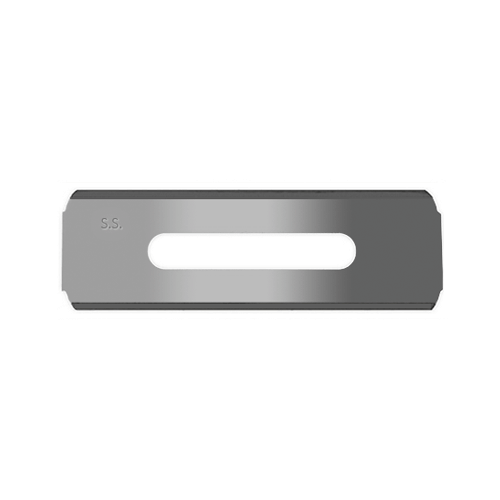
Sollex 5Z is a slotted industrial slitter blade with Zero-Friction coating, developed for demanding film slitting applications where friction, heat, material drag and sticking can affect cutting performance.
For this customer, the decisive factor was not only sharpness. The key was the combination of sharp edge geometry and low-friction coating.
The 5Z blade helped the agricultural film move through the cutting zone with less resistance. This reduced frictional heat, limited material build-up and helped maintain a cleaner cutting edge over time.
In a recycled agricultural blown film application, this was critical. The material was tough, variable and demanding. A standard blade could slit the film initially, but struggled to maintain stable performance. Sollex 5Z provided a more controlled and repeatable cutting process.
Results: cleaner slitting and improved process stability
The technical evaluation showed that Sollex 5Z provided the most robust result for the customer’s recycled agricultural blown film.
The blade delivered a clean edge without dust or bubbles in the tested agricultural film application. It also gave the customer a more stable slitting process compared with the previous blade setup.
47% fewer blade changes at the same blade cost
During the 14-day comparative production test, the competitor blade
required 628 blade changes, compared with 333 changes for the Sollex blade.
This represents 295 fewer blade changes — a reduction of approximately 47%. The two blade solutions had the same purchase price, meaning the improved performance was achieved without increasing the cost per blade.
Based on the average operating time between blade changes, the Sollex blade delivered approximately 89% better blade performance than the competitor blade under the tested production conditions.
Test results
- Competitor blade: 628 blade changes
- Sollex blade: 333 blade changes
- Difference: 295 fewer blade changes
- Blade performance improvement: 89%
Reduction in blade changes: 47%
The main improvements were:
- 89% better blade performance
- 47% fewer blade changes
- 295 fewer blade changes during the 14-day test
- Cleaner cut quality in a difficult agricultural film structure
- Reduced dust formation in the slitting zone
- Lower risk of bubbles, edge defects and unstable roll quality
- Better resistance to friction and heat build-up
- More predictable blade performance over time
- Reduced operator attention during production
- Improved confidence when running film with recycled plastic content
For the customer, the improvement was not limited to blade life. Reducing blade changes from 628 to 333 meant fewer blade-related interventions during production and a more stable slitting process. With 47% fewer blade changes and approximately 89% better blade performance, the Sollex blade provided a clear operational improvement over the previous solution.
Why 5Z was the right blade for this application
The customer’s problem was driven by more than abrasive wear. Friction, heat and material behaviour were central parts of the issue.
In agricultural film with recycled content, the blade must do more than stay sharp. It must maintain a clean and stable cutting action despite variation in material structure, additives, pigment and friction.
The Zero-Friction coating on Sollex 5Z helped reduce resistance between the blade and the film. This made the blade better suited for a tough blown film application where material drag and heat could otherwise lead to poorer edge quality, dust formation, bubbles and shorter blade life.
In this case, the correct blade choice was not about choosing the hardest blade available. It was about selecting the blade that matched the real cutting mechanism in the customer’s process.
The production test confirmed the improvement. Compared with the competitor blade, Sollex 5Z required 47% fewer blade changes and delivered approximately 89% better blade performance over the 14-day test period.
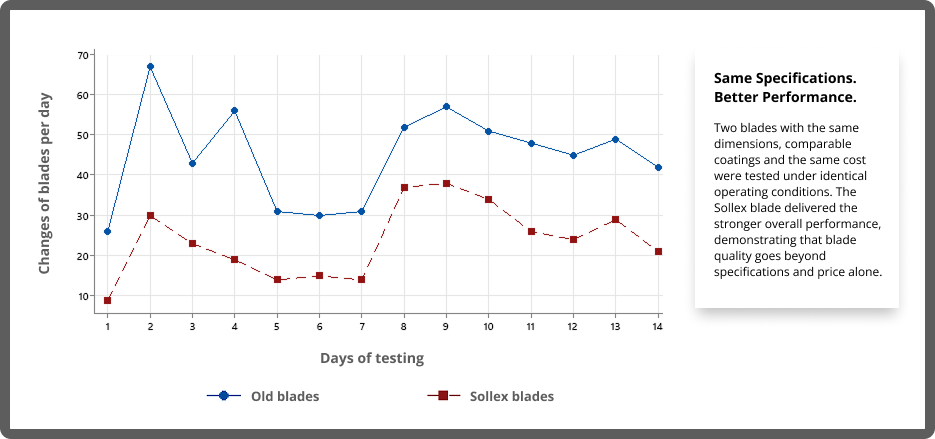
Figure: Comparative blade performance over 14 production days. Competitor: 628 blade changes. Sollex: 333 blade changes. Result: 47% fewer blade changes and approximately 89% better blade performance at the same blade cost.
Technical insight: recycled content is becoming a major challenge for the plastics industry
One key learning from the project was that recycled content can significantly change how agricultural film behaves during slitting.
PCR, PIR and other recycled plastic materials are becoming a major future challenge for the plastics industry. As producers increase the amount of recycled content in film structures, the material becomes more difficult to predict in production. This affects extrusion, film stability, roll quality and the cutting process.
Recycled plastic can behave differently from virgin material. When plastic has been recycled several times, it may become rougher, tougher and more inconsistent. Even when the film meets the required technical specification, it can create higher friction against the blade and become more difficult to slit cleanly.
In some cases, adding only 20–25% recycled content to the plastic blend can change the entire behaviour of the film. A blade that performs well on conventional film may suddenly create more friction, heat, dust formation, bubbles or unstable edge quality when recycled material is introduced.
For producers of silage film, bale wrap, mulch film, greenhouse film and tunnel film, blade selection must therefore be based on real material behaviour, not only the film category.
This is why Sollex recommends production-based testing when customers increase recycled content or change material recipes. In these applications, the right blade is not just a consumable. It is a process-critical component that helps control cut quality, uptime and total production cost.
Conclusion
When increased recycled plastic content made the agricultural blown film more demanding to slit, the customer needed a blade capable of maintaining clean cuts while delivering more stable performance over time.
Sollex carried out a structured blade evaluation under actual production conditions. Following the initial evaluation, Sollex 5Z was compared directly with a competitor blade over a 14-day period.
The competitor blade required 628 blade changes, while the Sollex blade required 333. This represents 295 fewer blade changes, a reduction of approximately 47%, and approximately 89% better blade performance measured by operating time between blade changes — at the same blade purchase price.
For the customer, the result was a more stable cutting process, fewer blade-related interventions and more predictable performance when processing demanding agricultural film with recycled content.
Need Support with Agricultural Film Slitting?
Are you experiencing slitting issues in agricultural film, recycled plastic film or other demanding blown film applications?
Sollex helps film producers identify the right blade, coating and cutting setup through technical analysis and production-based testing. Contact us to discuss your application and find a blade solution that improves cut quality, process stability and total cost per produced metre.