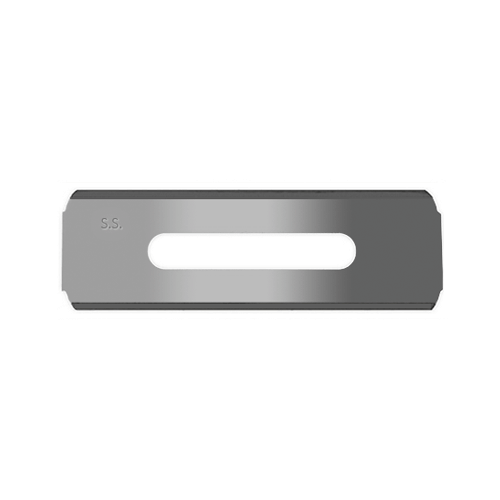
From 600 to 900 m/min: Blades Unlocks 50% More Output
— As Discussed at K Düsseldorf - The world's No.1 Trade Fair for Plastics and Rubber
There's a paradox at the heart of modern film and foil production. The machines are extraordinary — robust, precise, engineered to run at punishing speeds for hours on end. Rollers, extruders, winders: all built to handle enormous forces and volumes without breaking a sweat.
But it all comes down to the blade.
A thin strip of steel, a precisely ground edge, a geometry measured in microns. Everything the line produces — every meter of film, every roll of foil — passes through that edge. It's the most sensitive point in one of the most demanding industrial processes in the world. And it's the one place where the difference between a good result and a great result is often just a matter of knowing exactly which blade to use.
The World's Most Important Stage for Film and Foil
K Düsseldorf is the world's No. 1 trade fair for plastics and rubber — and for anyone working in film and foil converting, it's the essential event. Machinery manufacturers fill entire halls with equipment running live: extrusion lines, winding systems, laminating equipment, slitting and cutting stations. You see the full process, at scale, in action.
What K makes very clear, if you spend time on the floor, is how far machine technology has come — and how much the blade still matters. The equipment handles production at speeds and volumes that would have been unthinkable a generation ago. But consistently clean slitting at those speeds? That still comes down to edge geometry, blade material, and getting the setup exactly right.
Sollex has visited K 2010, K 2013, K 2016, K 2019, and K 2025 — and the conversations at each edition have followed a similar pattern. Producers aren't just looking for a blade supplier. They're looking for a way to push their lines harder and with tougher materials such as PIR and PCR without sacrificing the edge quality their final product.
The 50% Output Question
If a film line runs at 600 m/min and you can raise that to 900 m/min with a blade that holds a stable, clean edge at higher speed — you've just increased your output by 50%. Same line. Same crew. Same shift hours. Fifty percent more product.
That number is real, and it's why blade selection is not a purchasing afterthought. It's a production engineering decision.
The challenge is that film and foil converting is genuinely sensitive. Many producers deliberately split the process into two steps — producing film at high speed in one pass, then converting it to final dimensions separately — precisely because trying to slit cleanly at full production speed introduces too many edge quality risks. If you can collapse those two steps into one reliable inline process, the cost savings are significant for major producers. The right blade is often what makes that possible.
Speed alone isn't the goal. The blade also has to deliver:
- Clean, consistent edges — no fray, no fuzz, no micro-tears that cause downstream issues
- Stable performance over long runs — not just at the start of a reel, but through the full production cycle
- Compatibility with the material — because BOPP, PET, CPP, aluminium foil, and laminated structures each behave differently under the knife
When all of that comes together, you don't just get more output. You get improved final product quality and better output.
Why Different Materials Need Different Blades
There's no universal blade answer — material and process determines everything.
BOPP and CPP need sharp edges to avoid distortion at speed. PP and sometimes PET is abrasive and rewards solid carbide that holds geometry over long runs. Aluminium foil is tear-prone, making edge geometry critical. Laminated and adhesive-backed films require coatings to avoid material build-ups and disciplined cleaning intervals.
The most challenging materials right now are PIR (post-industrial recycled) and PCR (post-consumer recycled) films. Inconsistent thickness, stiffness, and contamination particles accelerate edge wear fast — a blade running cleanly at 500 m/min on virgin PET may fray or dust on the recycled equivalent at half that speed. As sustainability pressures push more producers toward recycled resin, getting the blade right on these materials is one of the most consequential conversations in film converting today.
What Sollex Brings to K
Sollex is a Swedish industrial blade manufacturer with deep specialisation in film, foil, and flexible packaging converting. Sollex focus on matching blade material, edge geometry, and coating to the specific demands of each converting application.
At K, that translates to practical conversations with engineers and production managers who know their lines and know where the bottlenecks are. The starting point is always the same: what are you running, at what speed, on what machine, and what does the defect or the limitation look like?
From there, the blade recommendation follows — along with guidance on setup parameters, cleaning intervals, and the small adjustments that often close the gap between a line running at 80% of its potential and one running at 100%.
K 2025 confirmed what previous editions had shown: the blade conversation in film and foil converting is becoming more technically demanding, not less. Faster lines, tighter tolerances, more complex material stacks, and growing pressure to bring slitting inline rather than as a separate step are all pushing producers to look harder at what's happening at the cutting edge.
Running film or foil at less than your line's full potential? Tell us your material, machine, speed window, and current blade setup. We'll tell you where the margin is.