Plastic Packaging Trends, PPWR & EU Packaging Regulations
PPWR is changing the requirements for packaging across the EU. For flexible packaging producers, this also means new material structures, more recycled content and new challenges in cutting and slitting.
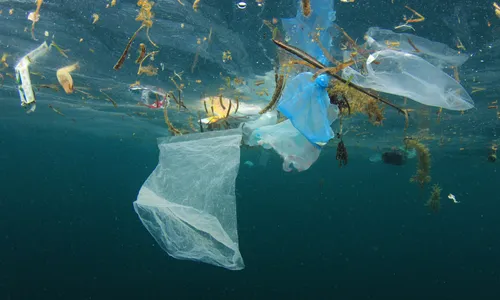 Plastic is a really important lightweight and flexible material. Plastic packaging helps to ensure quality transportation, food safety, and reduces food waste. But plastic waste is a severe problem for the environment. Plastic is currently produced, used, and discarded in a harmful way. There are environmental problems in production and millions of tonnes of litter end up in oceans every year.
Moreover only a small fraction of all modern plastics fall into the sustainable cycle. More than 70% is burned thus generating CO2 emissions. Can Planet Earth continue with landfills and creating CO2 by burning plastics?
Nevertheless, plastic itself is not a threat. Plastic can be reusable, recyclable, and compostable. This text is about the upcoming packaging regulations and what plastic packaging manufacturers can do to thrive in business. Sollex aspect is adapted knives and blades for cutting new types of plastic films such as recyclable, compostable, and made from renewable sources.
The European Union’s Packaging and Packaging Waste Regulation (PPWR) is now an important part of this transition. The regulation applies across the EU from 12 August 2026 and introduces new requirements concerning packaging recyclability, recycled content, packaging reduction, reuse and labelling.
For flexible packaging manufacturers and converters, PPWR is also influencing the development of new film structures and materials. Increased use of recycled content and packaging designed for improved recyclability can change how films behave during slitting and cutting.
Packaging Trends and Regulations
Significant government actions and regulations will have a strong impact on the packaging industry. The upcoming regulations will particularly affect everyone involved in plastic packaging. It will also require major changes to current manufacturing processes.
Packaging and Packaging Waste Regulation (PPWR)
The EU Packaging and Packaging Waste Regulation (PPWR) establishes common rules for packaging and packaging waste across the European Union. It entered into force in February 2025 and applies from 12 August 2026.
The regulation covers the full life cycle of packaging and places greater focus on recyclability, recycled plastic content, packaging reduction, reuse and harmonised labelling. Several important requirements will be phased in over the coming years, including stronger design-for-recycling requirements and mandatory recycled content in certain plastic packaging from 2030.
For the flexible packaging industry, these changes increase the focus on recyclable packaging structures, recycled materials and more resource-efficient packaging.
McKinsey’s research on sustainability in packaging shows that this transition is already a major priority across the industry. Around 75% of organizations have made clear sustainable-packaging commitments, while fewer than 30% are well prepared to meet their goals and regulatory requirements.
With PPWR now being implemented across the EU, the pressure to reduce material use, improve recyclability and increase recycled content is becoming more concrete for packaging manufacturers and converters.
Plastics in a Circular Economy and European strategy
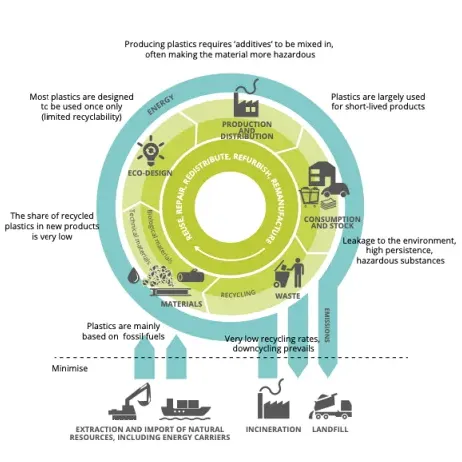 The European Union has a published report called “A European Strategy for Plastics in a Circular Economy''. This is really interesting reading for anyone in packaging. Accordingly, the European plastic demand in 2015 was 49 million tonnes. The main part 40% was packaging. Europe generates 25.8 million tonnes of plastic waste each year. Less than 30% of this waste is recycled. 59% of this waste is generated from packaging with landfilling and incineration simply turning our plastic waste into littering and CO2. Of all new plastics only 6% comes from recycled plastics. If all plastics could be recycled it is estimated that 3.5 billion barrels of oil could be saved each year. (2)
Improving the quality and economics of plastics recycling is a core objective of the European Strategy for the nearest future. The Strategy includes improving product design, boosting recycled content, and improving separate collection of plastic waste.
There will be a European transition from a linear to a circular production economy. The traditional linear model of production involves the use of newly produced raw materials and newly extracted natural resources to produce new products and materials. The circular economy, on the other hand, is based on the principles of reducing waste and pollution in production, keeping products and materials in use and regenerating natural systems by minimizing the amount of new raw materials required. This new kind of economy is increasingly on the radar screen and is gaining popularity. The circular economy is our immediate future.
“Strategy for Plastics in a Circular Economy” is the first EU policy framework which adopts a material-specific life cycle approach to integrate circular design, use, reuse and recycling into the plastics value chain. The strategy sets a clear vision with quantitative targets at EU level to ensure that by 2030 all plastic packaging supplied to the EU market is reusable, compostable or recyclable.
The Paris Agreement to Limit CO2 Emissions
Another important agreement concerning the future of plastic packaging production is the Paris Agreement. According to the UN, as of June 2021 there are 195 signatories to the Paris Agreement to limit their CO2 emissions (3). However, the Paris Agreement permits countries to set their own ambitions within certain parameters. The EU, in particular, has stated its ambition to cut CO2 emissions by 2030 by 55 percent in comparison with 1990 levels (4). This commitment has been made as part of the EU Green Deal (5), which is a comprehensive package of taxed and non-taxed regulations.
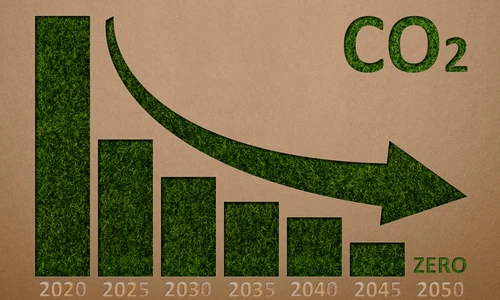
Green Deal | Net zero emissions - 2050; 50-55% emissions reductions from 1990 levels by 2030 |
Plastic Tax | Revenue collection based on non recycled plastic consumption; each to design Plastic Tax |
Energy Taxation Directive ETD | Broad tax base now including aviation, maritime and fishing; tax rates according to energy and environment content; price signals reinforcing innovation and investment |
Carbon Border Adjustment Mechanism CBAM | Shadow ETS applied to certain high emissions imported covered goods; Aim applies equivalent carbon costs between imports and locally produced goods |
Emissions Trading System ETS | Pricing of carbon inside the EU with many sectors regulated through the ETS; withdrawal of some free allocations in parallel with CBAM introduction |
European “Plastic Tax”
 As of January 1, 2021, a new source of revenue to the EU budget for 2021-2027 was introduced. A "plastic tax", based on the amount of non-recycled plastic packaging waste. All member states have agreed to this contribution. The tax contribution is calculated by the weight of non-recycled plastic packaging waste with a uniform rate of EUR 0.80 per kilogram. The EU’s plastics tax is one of several tax reforms proposed as part of the Green Deal which aims to reduce consumption of raw materials and waste, promoting the move towards a circular economy. (7)
What PPWR Means for Packaging Manufacturers
PPWR introduces several requirements that packaging manufacturers, converters and brand owners need to prepare for. These include increased focus on design for recycling, recycled content in plastic packaging, packaging minimisation, harmonised labelling and reuse for certain packaging categories.
For flexible packaging producers, this is contributing to continued development of recyclable PE and PP structures, films containing PCR and other packaging structures designed to improve recyclability.
It is important to distinguish between PPWR requirements and industry developments. PPWR does not generally require all flexible packaging to be mono-material. However, mono-material PE and PP structures are one approach being developed by the industry to improve recyclability.
Upswing for Mechanical Recycling of Plastic Packaging
 Mike Baxter, External Affairs director at packaging giant Berry Global predicts PVC and PS to disappear due to legislation. PP and HD are the future. ”Don’t replace plastic with some other packaging with higher CO2 emissions. Plastics have low total green gas contribution compared with alternatives”. So the Berry Global way forward is to continue to use plastic packaging but in a recycling way. Chemical recycling uses 10 times as much Carbon dioxide compared with Mechanical recycling. In short the big problem is not plastic, it is climate change and our CO2 emissions when burning plastics.
Packaging trends for the near future
For European packaging manufacturers, recyclability, recycled content and material reduction are becoming increasingly important as PPWR requirements are introduced. This is accelerating the development of packaging designed for recycling, increased use of recycled plastics and new flexible packaging structures.
Many things are happening in packaging. Plastic diet is a hot topic. Plastic spoons, forks, and straws are gone. Plastic bags are so heavily taxed that no one is buying them in Europe. Polyester or Polyethylene terephthalate (PET) are being swapped for sustainable textile or bio based materials. According to Directive 94/62/EC on packaging and packaging waste by 31 December 2025, at least 65% by weight of all packaging waste must be recycled (10). EU countries should ensure that systems are set up to provide for the return and/or collection of used packaging and/or packaging waste, as well as the reuse or recovery including recycling of the packaging and/or packaging waste collected.

Packaging in general should be:
- Reusable: Packaging can be used for different purposes
- Recyclable: Making sure all materials are circular
- Compostable: Materials should be returnable back to earth
- and made from Renewable sources
In addition it should be lightweight, reused, refilled or swapped for paper in some cases. Some of the most important developments in flexible packaging today are recyclability, increased recycled content, material reduction and packaging designed for a more circular economy. Sustainable packaging is based on three major actions; drive towards 100% recyclable packaging, minimizing harm from non-recycled materials, and looking into packaging from a full lifecycle impact (GHG). Serious manufacturers need to look towards a sustainable operational strategy. There is an urgent need to increase collaborations, pilots and new solutions. For the packaging industry it is time to act and scale it up urgently.
In essence producers, recyclers, retailers, and consumers need greater cooperation to handle the future. There are three ways forward: Reusable, Recyclable, or Compostable. Materials need to be from Renewable sources. Basically we need to collect and recycle materials. In addition packaging needs to be compostable or made in mono materials for recyclability.
How PPWR Affects Plastic Film Converting and Slitting
 As PPWR and the transition towards more recyclable packaging change the materials used in flexible packaging, converters are also seeing changes in the cutting process. Higher recycled content, new polymer combinations, thinner films and packaging designed for improved recyclability can all affect how a film behaves during slitting and cutting.
Materials containing PCR (post-consumer recycled) or PIR (post-industrial recycled) plastic can behave differently from virgin film. Variations in polymer composition, recycled content, additives and fillers can affect friction, blade wear, edge quality and process stability. A blade that performs well on one film structure may therefore not give the same result on another.
Sollex supplies industrial knives and blades for cutting a wide range of recyclable, recycled and renewable film materials. Depending on the application, adjustments to the blade material, cutting edge, angle or coating can help improve blade life and maintain a cleaner, more stable cut.
You can read more about PCR plastic and how recycled content affects cutting and slitting here.
Every plastic film formulation is different, and even changes in the percentage of recycled content or additives can influence cutting performance. For this reason, we recommend blades based on the specific material, machine and cutting process rather than using one solution for every application.
If you are experiencing short blade life, poor edge quality or unstable slitting when changing to a new film structure, Sollex can help you evaluate the application and recommend a suitable blade.
Sources:
- Sustainability in packaging: Five key levers for significant impact. Online available at https://www.mckinsey.com/industries/advanced-electronics/our-insights/sustainability-in-packaging-five-key-levers-for-significant-impact, last accessed on 12 Dec 2022.
- A European Strategy for Plastics in a Circular Economy. Online available at https://eur-lex.europa.eu/legal-content/EN/TXT/?uri=COM:2018:0028:FIN, last accessed on 12 Dec 2022.
- The Paris Agreement. United Nations. Online available at https://www.un.org/en/climatechange/paris-agreement, last accessed on 12 Dec 2022.
- State of the Union: Commission raises climate ambition and proposes 55% cut in emissions by 2030. Online available at https://ec.europa.eu/commission/presscorner/detail/en/IP_20_1599, last accessed on 12 Dec 2022.
- A European Green Deal. Online available at https://ec.europa.eu/info/strategy/priorities-2019-2024/european-green-deal_en, last accessed on 12 Dec 2022.
- KPMG Plastic Tax. Publication date: September 2021. Online available at https://assets.kpmg/content/dam/kpmg/xx/pdf/2021/09/plastic-tax.pdf, last accessed on 12 Dec 2022.
- Importance of environmental taxes - Plastic Packaging Tax. Online available at https://www.pwc.nl/en/insights-and-publications/tax-news/vat/importance-of-environmental-taxes-plastic-packaging-tax.html, last accessed on 12 Dec 2022.
- Global Waste Management Outlook 2015
- Spain introduces plastic tax. Online available at https://marosavat.com/spain-introduces-plastic-tax/, last accessed on 12 Dec 2022.
- Directive 94/62/EC on packaging and packaging waste. Online available at https://eur-lex.europa.eu/legal-content/EN/TXT/?qid=1595838206165&uri=LEGISSUM%3Al21207, last accessed on 12 Dec 2022.
- Letcher, T. M. (ed.) (2020): PLASTIC WASTE AND RECYCLING, Environmental impact, societal issues: ELSEVIER ACADEMIC Press. Online available at https://www.elsevier.com/books/plastic-waste-and-recycling/letcher/978-0-12-817880-5, last accessed on 12 Dec 2022.
- Regulation (EU) 2025/40 on packaging and packaging waste (Packaging and Packaging Waste Regulation, PPWR). Official Journal of the European Union. Online available at: https://eur-lex.europa.eu/eli/reg/2025/40/oj/eng, last accessed on 24 Sep 2026.
- Frequently Asked Questions on the Packaging and Packaging Waste Regulation (PPWR). European Commission. Online available at: https://environment.ec.europa.eu/publications/faq-packaging-and-packaging-waste-regulation-ppwr_en, last accessed on 24 Sep 2026.
- Packaging & Packaging Waste Regulation (PPWR). European Commission. Online available at: https://environment.ec.europa.eu/topics/waste-and-recycling/packaging-waste/packaging-packaging-waste-regulation_en, last accessed on 24 Sep 2026.