


Blades for Battery Industry
Right blades for copper and aluminum foil improve lithium-ion battery quality, reduce defects, and enhance safety.
Written for professionals in the foil and battery industries, this article will be useful to copper and aluminum foil producers, metal foil suppliers and converters, and anyone involved in lithium-ion battery electrode manufacturing who needs reliable cutting and slitting solutions.
Slitting Solutions for Copper and Aluminum Foil in Li Ion Cell Manufacturing
Lithium ion batteries are now fundamental in electronic devices such as laptop computers and cellular phones, and their importance continues to grow in EV battery and energy storage systems. In lithium ion batteries, copper foil is used as the anode current collector foil, while aluminum foil is used as the cathode current collector foil. These materials form the conductive backbone of the electrode structure after slurry coating and drying. During the coating process, slurry is applied uniformly on copper foil for the negative electrode and on aluminum foil for the positive electrode, followed by drying to form a stable film layer.
The quality of slitting blades used for cutting these coated and uncoated battery foils directly influences burr formation, particle contamination, coating integrity, rewinding stability, and ultimately battery safety. Even small burrs generated during electrode shaping can puncture the separator during winding or stacking. Over time, these micro defects may lead to internal short circuits inside lithium ion batteries.
Copper Foil for Lithium Ion Battery Anodes
 Copper foil, often referred to as battery copper foil or battery grade copper foil, is the primary material used as the current collector of the anode in lithium ion batteries. It is commonly described as rolled copper foil for battery anodes, graphite coated copper foil for lab battery anode electrode sheets, high end ultra thin copper foil with surface coating technologies.
Copper foil is selected due to its excellent electrical conductivity and workability. It functions as the anode current collector because it remains stable at the low potential of the negative electrode. However, from a slitting perspective, copper foil presents serious technical challenges.
Copper is highly ductile. During cutting on foil slitting machines or aluminum and copper foil slitting rewinding machines, it tends to plastically deform instead of separating cleanly. If circular slitter blades are not optimized in geometry and sharpness, burr formation, edge roll over, and feathering occur.
Aluminum Foil for Lithium Ion Battery Cathodes
 Aluminum foil is the only material suited for lithium ion battery cathode current collectors. There are no substitutes. It is commonly described as battery aluminum foil, aluminum foil rolls for battery manufacturing, etched aluminum foil, or battery grade aluminum foil.
Aluminum has lower specific gravity, lower electrical resistivity, and higher thermal conductivity compared to many alternatives. It does not dissolve at high action potential levels in non aqueous electrolyte solutions used in lithium ion batteries. These properties make aluminum ideal as a cathode collector. Carbon coated aluminum foil for lithium battery applications is used to enhance conductivity and interfacial stability.
Battery aluminum foil must meet strict quality requirements. The surface must be uniform in color, clean, and flat, without roll marks, pitting, pinholes, corrosion marks, creases, mottling, bright lines, oil contamination, or visible oil spots.
During cutting on lithium battery aluminum foil slitters or metal foil slitting machines, aluminum can adhere to blade edges. Material build up increases friction, changes cutting force, and accelerates edge degradation. Without optimized lithium battery slitting knives, this leads to unstable slit quality and coating damage.
Challenges in cutting foil for battery production
 Copper and aluminum foil for lithium ion battery production are processed on specialized foil slitters and foil slitting machines. These include aluminum and copper foil slitting rewinding machines and lithium battery aluminum foil slitters designed for ultra thin materials. At thicknesses typically between 6 and 20 microns, both cathode and anode foil for lithium ion batteries are extremely sensitive to tension imbalance and cutting force variation. Small deviations in blade overlap, knife angle, or edge radius can dramatically affect slit geometry. The performance of lithium battery slitting knives in these machines determines whether the process remains stable across multiple lanes and high line speeds.
Common Problems When Cutting Cathode and Anode Foil
When slitting copper and aluminum foil for lithium ion battery manufacturing, engineers repeatedly encounter technically critical issues linked to material ductility, thin gauge, surface coatings, and extreme cleanliness requirements. In practice, battery manufacturers address these problems by carefully selecting slitting methods (razor, shear, or score), using ultra-sharp and wear-resistant blades, optimizing blade angles and overlap, and tightly controlling tension and cleanliness. Even small improvements in cutting stability and blade quality can have a disproportionate impact on yield, safety, and long-term battery reliability.
Problems when cutting foils for lithium ion battery manufacturing:
- Burr formation on copper and aluminium foil edges
One of the most common problems is burr formation and edge defects. Copper foil, in particular, is very ductile and tends to plastically deform instead of fracturing cleanly. If the blade geometry, sharpness, or slitting method is not optimized, micro-burrs, edge roll-over, or feathering appear. These defects are dangerous in batteries: even microscopic burrs can penetrate separators during winding or stacking and later cause internal short circuits.
- Metal particle and dust generation during cutting
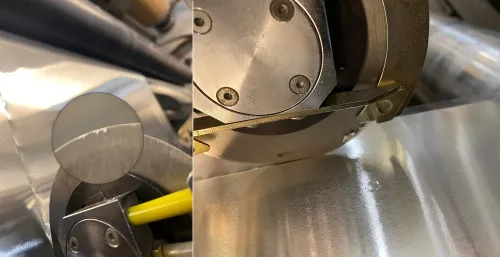 Another recurring issue is particle generation and contamination. Poor cutting conditions, chipped blade edges, or incorrect blade coatings can generate metallic dust or fine particles. In battery production, even sub-micron metal particles are unacceptable, as they can migrate into the cell and become failure points. Copper dust is especially problematic because of its electrical conductivity and tendency to embed into coated electrode surfaces.
- Edge waviness and unstable slit geometry
Manufacturers also struggle with foil stretching, wrinkling, and edge waviness. Both aluminium and copper foils used for batteries are extremely thin, often in the range of 6–20 µm. Excessive cutting force, incorrect tension control, or worn blades can stretch the foil during slitting. This leads to unstable edges, poor winding behavior, telescoping rolls, and downstream issues in coating, calendaring, or stacking.
- Telescoping or unstable rewinding of slit rolls
Telescoping during foil slitting refers to a defect where the rewound slit roll develops a stepped or cone-shaped edge because the layers shift sideways instead of forming a straight cylinder. Although it appears as a winding defect, telescoping is often rooted in unstable cutting conditions and progressive blade wear upstream.
- Rapid blade wear when cutting copper foil, chipped or micro-damaged blade edges causing quality drift, frequent blade changes reducing line uptime
 A related challenge is rapid blade wear and unstable tool life. Copper foil is abrasive at the micro level, while aluminium tends to adhere to cutting edges. This combination accelerates edge degradation, especially if standard steel blades are used. As blades dull, cut quality degrades quickly, increasing burr size, particle generation, and scrap rates. Frequent blade changes then reduce line uptime and increase cost per meter slit.
- Coating damage, delamination and material build-up on blade edges
Finally, there is the issue of coating damage, delamination or flaking after slitting, coating cracking at the cut edge, active material loss at electrode edges. Many battery foils are coated with active materials before slitting. If the cutting edge is not sharp enough or the cutting mechanics are incorrect, the coating can crack, flake, or delaminate at the edge. This not only creates particles but also reduces the effective electrode area and impacts cell performance and cycle life.
Proven Performance in Battery Foil Slitting
Sollex is already supplying knives to customers operating in the battery segment, and their continued purchasing confirms the commercial value of our solutions in this demanding industry. For battery manufacturers and converters, performance must be demonstrated under real production conditions, where consistency, cleanliness, uptime, and process stability are essential. In this environment, knife quality is not a secondary consideration. It is a critical factor in overall manufacturing performance.
Our experience in the battery segment shows that optimized slitting knives can deliver substantial improvements across the production process. Customers using our knives for copper foil, aluminum foil, and coated electrode materials have reported more stable slitting performance, improved edge quality, and a more consistent process over extended production runs. These improvements are particularly important in battery manufacturing, where even minor deviations in cut quality can affect downstream handling, rewinding, yield, and product reliability.
The positive impact is not limited to the cut edge itself. High-performance knives contribute to lower burr formation, reduced risk of particle generation, improved roll quality, and fewer process interruptions. In practice, this supports greater production efficiency, more predictable output, and better control in applications where tolerances are extremely tight and the cost of instability is high.
Customers in this segment have also seen clear operational benefits in terms of tool life and maintenance intervals. Longer-lasting knives and more consistent cutting performance reduce the frequency of blade changes, which in turn supports higher uptime and lower total operating cost. In high-volume battery foil processing, these gains can make a meaningful difference to both productivity and process economics.
What distinguishes Sollex is not only the quality of the knife itself, but also our understanding of the converting process around it. Battery foil slitting is influenced by a combination of material properties, coating characteristics, machine configuration, tension control, and operating speeds. Delivering reliable knife performance therefore requires both product expertise and application knowledge. Our work with customers in this segment reflects that approach.
The fact that we already have active, purchasing customers in the battery industry demonstrates that Sollex is not approaching this segment from a purely theoretical perspective. Our knives are already in use in real production environments, where they are contributing to improved process stability, better cut quality, and measurable operational benefits.
Sollex Blades for Lithium Ion Battery Foil Slitting
Sollex offers slitter knives for lithium ion battery electrode sheets specifically engineered for aluminum cathode foil and copper anode foil materials used in Li ion cells.
The Sollex circular slitter blade for lithium battery anode copper foil and the slitter blade for lithium battery cathode aluminum foil are designed around a controlled interaction between top circular knife and bottom knife. The geometry is optimized for thin and sensitive materials.
The blade design controls slitting forces, reduces friction and deformation, and ensures a highly repeatable slitting process. Precisely defined knife geometry minimizes edge impact and limits burr formation.
Wear and heat generation are reduced through optimized load distribution, blade flexibility, edge hardness, and friction control. This extends blade operating lifetime and improves output quality for lithium battery manufacturers.
The design is adapted for integration into existing foil slitting machines and aluminum and copper foil slitting rewinding systems. All critical design parameters are kept confidential to protect customer competitive advantage.
The Sollex slitting blade design has been rigorously tested and proven by leading companies in automotive, EV battery, and advanced packaging sectors. Its performance under high precision foil production confirms Sollex expertise in critical aluminum and copper foil applications for lithium ion batteries.
How can Sollex help you?
If you are in need of blades or machine knives with performance and durability, Sollex is a good supplier. We have an extensive range of knives and blades in stock. We can also help our customers with blade design, coatings, materials, polishing, and oils for improved durability and performance. Contact us and we will help as best we can.
FAQ
Q: Why is slitting quality critical in lithium-ion battery foil production?
A: Copper and aluminum foils form the current collectors in lithium-ion battery electrodes. Poor slitting quality can create burrs, particles, and coating damage that may puncture separators, cause internal short circuits, and compromise long-term battery safety.
Q: Why is copper foil particularly difficult to cut?
A: Copper is highly ductile and tends to plastically deform rather than fracture cleanly. If blade geometry and sharpness are not optimized, burr formation, edge roll-over, and feathering occur.
Q: What problems occur when slitting aluminum foil for battery cathodes?
A: Aluminum can adhere to the blade edge during slitting. This material build-up increases friction, alters cutting force, accelerates edge degradation, and may damage electrode coatings.
Q: Why are burrs especially dangerous in battery electrode foils?
A: Even microscopic burrs on copper or aluminum foil edges can penetrate the separator during cell winding or stacking. Over time, this may lead to internal short circuits and cell failure.
Q: How does particle generation affect lithium-ion battery manufacturing?
A: Metallic dust or fine particles generated during slitting are unacceptable in battery production. Conductive copper or aluminum particles can migrate into the cell and become critical failure points.
Q: What causes edge waviness and unstable slit geometry?
A: Excessive cutting force, worn blades, incorrect overlap, or poor tension control can stretch ultra-thin foils during slitting, leading to wrinkling, telescoping rolls, and unstable downstream processing.
Q: Why is blade geometry more important than sharpness alone?
A: In ultra-thin foil slitting, small deviations in knife angle, overlap, or edge radius dramatically affect slit quality. Controlled geometry ensures repeatable cutting forces and minimizes burr and particle generation.
Q: Are specialized slitting knives required for lithium-ion battery foil production?
A: Yes. Lithium-ion battery copper and aluminum foils require precision-engineered slitting knives designed specifically for ultra-thin, highly sensitive materials and high-speed multi-lane production.


